It’s here! Our latest issue is officially live and ready for you to dive into.
CALL FOR PAPERS
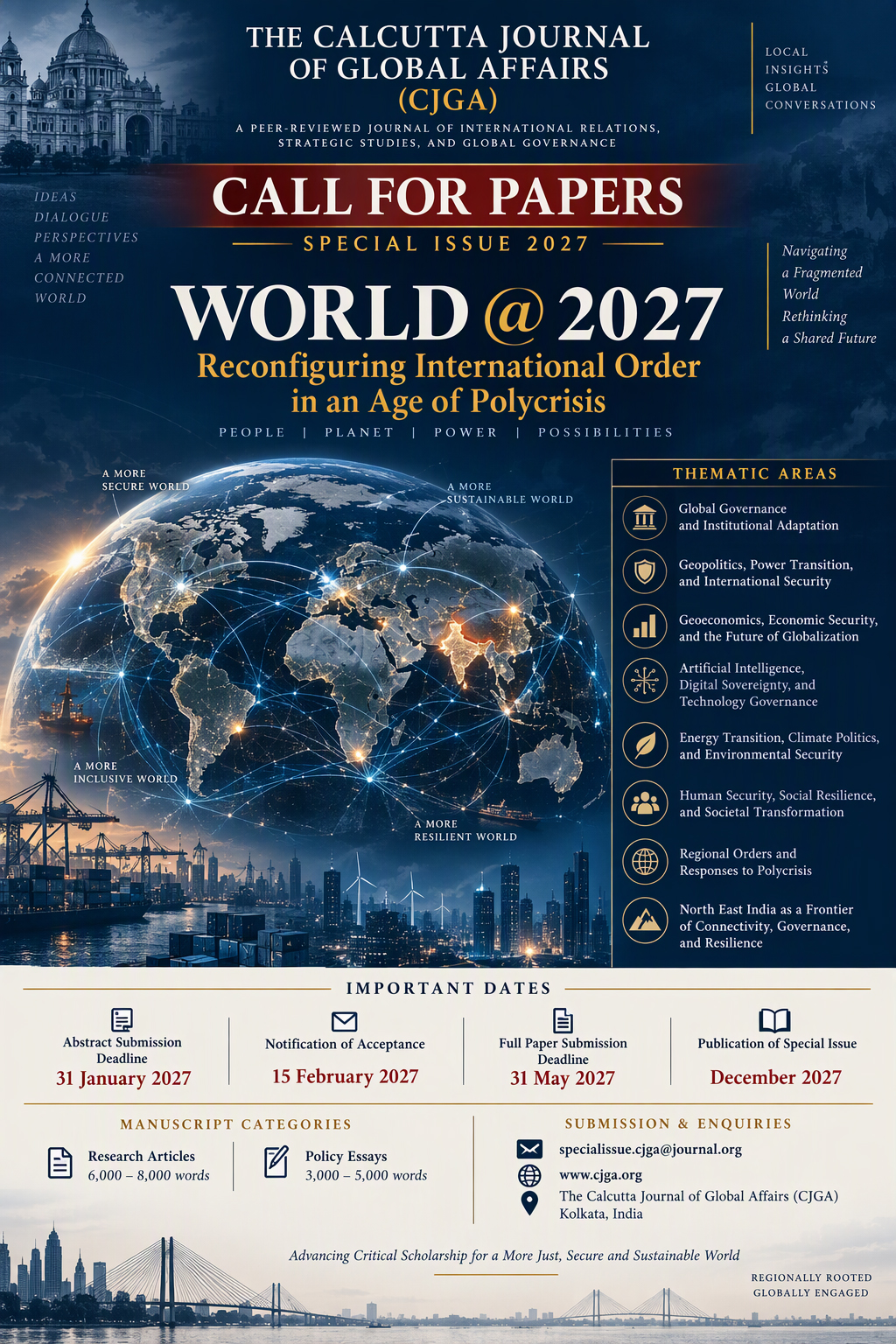
SPECIAL ISSUE OF THE CALCUTTA JOURNAL OF GLOBAL AFFAIRS (CJGA)
World @ 2027: Reconfiguring International Order in an Age of Polycrisis
Call for Scholarly Contributions
The Calcutta Journal of Global Affairs (CJGA) invites original research articles and policy essays for a special issue entitled “World @ 2027: Reconfiguring International Order in an Age of Polycrisis”. This special issue seeks to advance scholarly understanding of the transformations currently reshaping global politics, international political economy, governance, security, technology, and society amid an increasingly complex and uncertain international environment.
Background and Rationale
The contemporary international system is undergoing a period of profound transformation marked by the simultaneous interaction of geopolitical, economic, technological, environmental, and societal disruptions. While the COVID-19 pandemic exposed significant vulnerabilities within global governance institutions, international organizations, public health systems, and transnational supply chains, subsequent developments have demonstrated that these disruptions are neither temporary nor isolated. Rather, they reflect deeper structural shifts associated with changing distributions of power, contested globalization, technological disruption, ecological pressures, and evolving patterns of interdependence.
Recent scholarship has increasingly employed the concept of polycrisis to characterize this emerging condition. Unlike conventional understandings of crisis as discrete and episodic phenomena, polycrisis refers to a systemic condition in which multiple crises interact across sectors and scales, generating mutually reinforcing feedback loops and cascading consequences that transcend national and institutional boundaries. This perspective challenges linear and compartmentalized approaches to global affairs by emphasizing complexity, interconnectedness, and the co-constitutive nature of contemporary challenges.
From the standpoint of International Relations theory, the current moment raises fundamental questions concerning the future of international order. Liberal institutionalist assumptions regarding the stabilizing effects of economic interdependence and multilateral cooperation increasingly confront evidence of geopolitical rivalry, institutional contestation, economic securitization, and strategic fragmentation. Simultaneously, realist perspectives emphasizing power transitions and security competition have regained prominence amid intensifying geopolitical rivalries. Yet neither paradigm alone fully captures the multidimensional nature of contemporary transformation. The intersection of geoeconomic competition, technological rivalry, environmental stress, societal vulnerability, and governance deficits necessitates analytical frameworks capable of bridging traditionally distinct domains of political, economic, technological, and ecological inquiry.
At the center of these debates lies a broader contestation over the future of globalization and global governance. While some scholars view current developments as indicative of deglobalization and the erosion of the liberal international order, others argue that globalization is being reconfigured rather than reversed. Concepts such as strategic autonomy, economic security, resilience, selective decoupling, friend-shoring, and technological sovereignty suggest that states are recalibrating the relationship between openness and security rather than abandoning interdependence altogether. These developments raise important theoretical questions regarding the evolving relationship among power, institutions, markets, technology, and governance in the twenty-first century.
The international system is simultaneously witnessing debates surrounding multipolarity, post-Western international order, competing models of governance, and the emergence of alternative institutional and normative frameworks. Advances in artificial intelligence, digital infrastructures, cyber capabilities, and emerging technologies are further transforming both the material and ideational foundations of global power while generating new arenas of competition, cooperation, and governance.
Against this backdrop, World @ 2027: Reconfiguring International Order in an Age of Polycrisis seeks to provide a forum for theoretically informed, empirically grounded, and policy-relevant scholarship examining the changing architecture of international order. The special issue welcomes contributions that critically engage with questions of systemic transformation, governance adaptation, resilience, order transition, and institutional change, while advancing scholarly debates on the future of global politics and governance.
Objectives of the Special Issue
This special issue aims to:
- Examine transformations in global and regional political orders under conditions of systemic uncertainty.
- Assess the implications of geoeconomic competition, economic security, and global fragmentation.
- Explore the role of technological innovation in reconfiguring power relations, governance structures, and strategic competition.
- Analyze the interconnections among security, resilience, sustainability, and development.
- Investigate the societal, political, and cultural consequences of contemporary global disruptions.
- Advance theoretical and policy debates concerning the future trajectory of international order and global governance.
Indicative Themes
The Editorial Team welcomes submissions addressing, but not limited to, the following themes:
I. Global Governance and International Institutions
- Crisis governance and institutional adaptation
- The future of multilateralism
- Reform and legitimacy of international organizations
- Global cooperation under conditions of uncertainty
- Governance responses to transnational and systemic risks
II. Geopolitics and International Security
- Multipolarity and shifting distributions of power
- Great-power competition and strategic rivalry
- Regional security architectures
- Strategic dynamics in the Indo-Pacific
- Contemporary armed conflicts and their systemic implications
- Order-building and security governance in a fragmented world
III. Geoeconomics and Economic Security
- Fragmentation and reconfiguration of globalization
- Supply-chain resilience and strategic decoupling
- Economic statecraft, sanctions, and coercive interdependence
- Critical minerals, rare earths, and resource competition
- Trade, finance, and economic security
- Industrial policy and strategic sectors in a changing global economy
IV. Technology, Artificial Intelligence, and Governance
- Artificial intelligence and global power transitions
- Digital sovereignty and data governance
- Technology competition and international order
- Cybersecurity and governance challenges
- Emerging technologies and strategic competition
- Ethical and regulatory frameworks for AI governance
V. Energy, Climate, and Environmental Politics
- Energy transitions and geopolitical change
- Climate governance and international cooperation
- Environmental challenges as security concerns
- Sustainable development under conditions of uncertainty
- Climate resilience and adaptation
- Ecological disruption and global governance
VI. Human Security and Social Resilience
- Health security and pandemic preparedness
- Migration, displacement, and demographic transformation
- Food and water security
- Social cohesion, identity, and societal adaptation
- Human security in the age of polycrisis
- Inequality, vulnerability, and resilience
VII. Regional Perspectives on Polycrisis
- Asia and the evolving balance of power
- Europe and strategic autonomy
- Africa and emerging development challenges
- Latin America and transformations in global governance
- The Middle East in a changing international order
- Comparative regional responses to systemic crises
VIII. North East India in an Era of Polycrisis and as a Frontier of Connectivity, Governance, and Resilience
Situated at the intersection of South Asia and Southeast Asia, North East India represents a significant geopolitical, economic, environmental, and socio-cultural frontier through which broader transformations in regional and global order can be examined. The region’s growing importance within India’s Act East Policy, Indo-Pacific strategies, regional connectivity initiatives, and subregional governance frameworks makes it an important site for understanding the interactions among security, development, identity, governance, and resilience.
Indicative topics include:
- North East India and the evolving Indo-Pacific discourse
- The Act East Policy and regional connectivity initiatives
- Borderlands, sovereignty, and transnational governance
- Cross-border trade, economic corridors, and regional integration
- BIMSTEC, BBIN, and subregional cooperation
- Infrastructure development and geoeconomic transformation
- Migration, citizenship, and border governance
- Ethnic conflict, peacebuilding, and human security
- Climate change, environmental vulnerability, and disaster resilience
- Water governance and transboundary river politics
- Indigenous communities, cultural resilience, and development
- Digital connectivity and emerging development pathways
Illustrative Research Questions
Prospective contributors may consider the following questions:
- How is the contemporary condition of polycrisis reshaping international order?
- To what extent do current global developments signal fragmentation, transformation, or renewal of globalization?
- How are international institutions adapting to increasingly interconnected and transboundary challenges?
- What forms of governance are most effective in addressing systemic risks and cascading crises?
- How are states balancing resilience, security, and economic interdependence?
- What role do emerging technologies play in contemporary geopolitical competition and global governance?
- How are changing global dynamics affecting local political, economic, and societal processes?
- How do regional experiences contribute to broader theoretical understandings of resilience, governance, and order transformation?
- How is North East India being repositioned within emerging Indo-Pacific and connectivity frameworks?
- What insights can borderland regions provide for understanding polycrisis, governance, and regional integration?
Submission Guidelines
Prospective contributors are invited to submit an extended abstract (400–500 words) containing:
- Title of the proposed paper
- Research problem and principal research question(s)
- Theoretical and/or conceptual framework
- Methodology and sources of evidence
- Central argument and anticipated findings
- Original contribution to existing scholarship
- Relevance to the theme of the special issue
Authors should also include:
- Name(s) of author(s)
- Institutional affiliation(s)
- Contact details
- Four to six keywords
- A short biographical note (100–150 words)
Preference will be given to proposals that demonstrate clear theoretical engagement, methodological rigor, and innovative analytical perspectives capable of advancing contemporary debates within international relations, international political economy, global governance, security studies, development studies, and related disciplines.
Please send a copy of your abstract in MS Word as e-mail attachment to Maj Gen Shib Nath Mukherjee, (Retd.), The Calcutta Journal of Global Affairs at ceners.kolkata@gmail.com or snmukherjee@ceners-k or shib47mukherjee@gmail.com
Manuscript Categories
- Research Articles: 6,000–8,000 words
- Policy Essays: 3,000–5,000 words
All submissions must be original, unpublished, and not under consideration elsewhere. Manuscripts will undergo a rigorous double-blind peer-review process and will be evaluated on the basis of:
- Originality and scholarly significance
- Theoretical contribution
- Methodological rigor
- Analytical depth
- Clarity of argument
- Relevance to the objectives of the special issue
Please consult our Guidelines for Authors for details on our house style for grammar and citations.
Concluding Note
As the international system approaches 2027, scholars and policymakers face fundamental questions concerning the future of global governance, economic interdependence, technological transformation, environmental sustainability, and societal resilience. The accelerating interaction of multiple crises challenges conventional analytical frameworks and necessitates renewed theoretical and empirical engagement with the changing nature of international order.
By bringing together diverse theoretical, empirical, and policy-oriented perspectives, this special issue seeks to advance critical scholarship on polycrisis as an emerging condition of global affairs and to deepen understanding of how interconnected disruptions are reshaping world politics, global governance, regional orders, and local experiences of transformation.
The Calcutta Journal of Global Affairs (CJGA) welcomes submissions from scholars, researchers, policy practitioners, and advanced doctoral candidates whose work contributes to a deeper theoretical and empirical understanding of an increasingly fragmented and uncertain global order.
Timeline
- Abstract Deadline: 31 January 2027
- Acceptance Notification: 15 February 2027
- Full Paper Submission: 31 May 2027
- Review Feedback: 31 July 2027
- Revised Submission: 30 September 2027
- Final Acceptance: 31 October 2027
- Publication: December 2027